














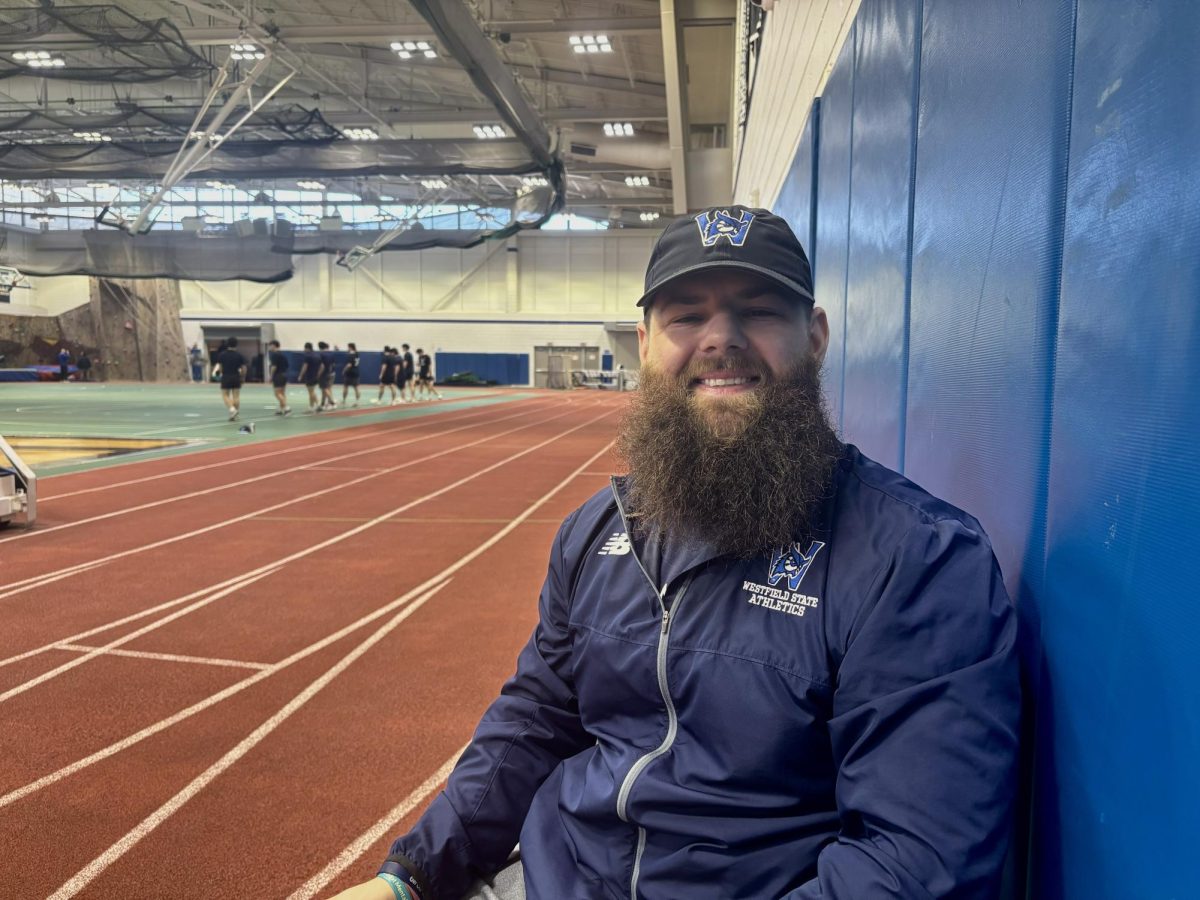
Since his arrival at Westfield State in January 2023, strength and conditioning coach Tucker
Bachand has been supporting Westfield’s 20 varsity athletic teams by providing each with
detailed programs to build strength for their sport.
The Connecticut native played three sports in high school, but fell in love with football, which he
played at Western Connecticut University and built many connections from. His passion for the
sport and for coaching led him to the world of strength and conditioning.
This interview was edited for clarity and length.
What was it like playing football in college?
Tucker: Fun, best five years I could say so far of life. Just the amount of people that you meet
from different walks of life. It was a different era than it is right now, so there wasn’t a lot of the
benefits that a lot of kids get nowadays, you know, of- of playing sports. It was just a bunch of
guys that just wanted to play football and it was kind of like a last chance place. Like we weren’t
good. The program that before, you know, my class got there, we weren’t good, and then we kind
of developed that program and went to back to back bowl games and we were the winningest
class as a senior class of the last 20 years. So we really put the program to what it is nowadays.
We all have a sense of pride, you know, kind of leaving our footprint there. And then on top of
that, just like the bonds you create is- is super special, right? I probably met close to 300 you
know, kids on our team in my four years, probably more than that. So, the coaches that I’ve met, I
still keep in touch with all my coaches. I know players that I played with that are coaching at
West Conn now. And then, you know, just the amount of weddings that I’ve been to of guys that I
played with is just astronomical as well. And even this May, my friend asked me to speak at his
wedding, so I will be officiating his wedding. So, yeah, like, the bond created in football is very
special. The bond created in athletics is super special, and that’s why I think that athletics is just
so super important.
Yeah, it really creates a community.
Tucker: Oh, yeah, 100 percent. 100 percent.
When did you first develop interest in working in strength and conditioning, and who
influenced you?
Tucker: So I was leaving school and I didn’t really know what to do… I did my last semester of
school for my undergrad. That’s all you did was that your last spring was an internship. So I did
that at our local Danbury YMCA, because I wanted to be a physical education, health, teacher,
football coach, that whole thing. And then I got some advice, and it was like, don’t go down that
route. And I was like, okay, there were not a lot of jobs open in the state of Connecticut at the
time. And then I would have to get my masters and I was like, I’m not doing all that. You know,
fast forward, I did get my masters, but I didn’t want to get my masters at all. I didn’t like school,
all that stuff, and just– it was just a lot of time. But um, just talked to all the friends that I had
known and that I worked with and a lot of them were as into fitness and lifting as I was and, you
know, he’s like, you should try strength and conditioning. I was like, okay. I don’t know what that
is.
We didn’t have a strength and conditioning coach. You know, we had uh, we had one of our
football coaches hand us a packet and said, you know, hey, I’ll open up the gym at 6 AM and
we’ll work out, and that’s what we did. So a bunch of guys that, you know, I know one guy that
was in that group, owns a gym, um another guy is on the coaching staff at University of Miami,
and they just played in the National championship, so he’s a strength coach for them. So, just that
small weight room we had, you know, us three in there. We actually grew that program to bigger
and bigger and bigger, um the head strength coach at Tufts now is is a West Conn grad that I
played football with, so, um, the network is super huge, um, so just learning that, and I was like,
okay, let me try it, so I did the internship at Yale. And then after Yale, they hooked me up with an
internship at University of Nevada, Las Vegas, and then, you know, from those two alone, it was
just football and football. And I was just, you know, being a football coach for 24 hours a day
and I absolutely loved it.
You know, you’re just into football and that’s all you’re really worrying about is, you know,
football, strength and conditioning, and athletics, so getting that first exposure, I was like, this is
what I wanna do. You know, is it all the glitz and the glam? Like, yeah, you know, it looks cool. I
work in a weight room all day. I work with student athletes, you know, it’s– it’s a fun time, but
you know, there’s– there’s pros and cons with anything, so definitely I finally knew that it was for
me. And, you know, from then on, you know, it just kind of just developed and grew and landed
me here through my journey to get here.
Do you wish that you had had a strength coach, like, what you’re doing now, when you
were in college?
Tucker: I would say yes, and no. Just cause, like you know how we all made it, it was just like a
bunch of guys just like were just… our football coach was a bodybuilder, he was a police officer,
and he just had an old bodybuilding packet that we did. Which is like, okay, we did it and it was
cool, and people got strong, right? But, um, I don’t know if I would want it the other way,
because we had a guy come in for like a semester and he had like kind of like an online
certification and it was just like not the right thing, so I guess it would be like the right coach at
the right time. You know, um just like athletes here, like not everyone has to like me, you know,
I’m not gonna get 100% buy in from every single team. But as long as you know you’re coming
from a place of respect rather than, you know, I’m just doing this just to babysit you for an hour,
type of thing. So um, I– I would say like, yes and no, like, yes would be great, but, like, if it was
a bad coach then no, you know what I’m saying? I would say yes or no, but I would say yes, just
cause we were just a bunch of a bunch of guys in a weight room doing bodybuilding stuff. You
know.
So, what’s your favorite thing about being the lift coach at Westfield?
Tucker: Ooh. There’s a lot. I mean, I definitely like our student athletes. like, even when I bring
in interns and just like the respect from our student athletes is a welcoming from our student
athletes, like the blue collar attitude from our athletes is what I really like. That’s kind of how I
grew up too, going to a state school as well. So I really like the types of people that we bring in
through these doors that are really welcoming to not only me, but to other people that I bring in. I
definitely like um… how much our athletes, I would say, want to get better. It’s always in their
mind to want to get better, then there’s step two of then putting in the work to get better. Right?
Our athletes are very respectful, and I think our athletes respond very well to coaching. You
know, if I say something, you know, no one’s gonna say anything bad to me or anything like that.
I guess that goes with the relationships that you build with your athletes. But if I tell someone to
do something, they’ll actually try it and do it that way rather than do their own thing. Just
because they know where I come from and what I want for my athletes and that’s the best, so.
Yeah, I think speaking as an athlete, we all have a lot of trust in you that you’re gonna help
us get to where we want to be the right way.
Tucker: I appreciate that. Yeah, no, it’s– it’s fun. I mean, I always tell people relationships are a
two way street, right? So if you come in, and you can speak for athletes on your team, that have
come in and it’s like, they just come in, they show face, they walk around, they talk the whole
time, it’s like, you didn’t get better, right? But then you can’t expect me to try and push you if
that’s your attitude, your energy, when you walk in, so but just like relationships, you know if I
expect you to talk to me, you don’t talk to me, then you can’t get mad at me for not talking to
you, cause you’re not talking to me. Right? So it’s the same exact thing. So, um that’s how I give
off energy for– you notice that with my– how I coach my athletes, that if you’re not bringing the
energy and talking back and forth, then it’s– it’s not gonna be there. Like, I need something to
bounce off of. For me to know where you’re standing and how you wanna be coached as well,
but if you just quiet the whole time, I don’t know what you like, I don’t know how you wanna be
coached. But there definitely has to be some type of communication, definitely in athletics, you
know, there should be communication in your sport, cause a lot of sports have that
communication side.
Absolutely. So, you manage about 20 teams here at Westfield? What’s that like?
Tucker: Yeah, just 20 by myself. No. Yeah, no, it’s– it’s great. It keeps me moving. I’m the type of
person that can’t sit still, so, like, I need to be moving, I need to be working, I need to be doing
other things. So, you know, having two teams in the room right now is– is nothing for me. You
know, so, usually at division one, you got 20 racks and you gotta be up and down and you got
kids on scholarship and you got kids that are making money and you gotta make sure that they
are good to go and as well as the kids of your developing as freshmen that they’re good to go in
that same hour block. So it’s just, it’s a lot of chaos, but it’s a lot of controlled chaos is what we
call it.
But doing a lot of back end work is probably the biggest thing. And I tell my interns to get all
your back end work done first, you know, rather than working from week one, week two week
three. Right now, I have you all planned out till spring break, right? So let’s talk about field
hockey. I have your whole entire plan for spring break, right? Because we’ll probably be testing
before spring break, and then after spring break, you’ll go into spring practice, so I need to
prepare you for those types of things. So what are the big things I need to prepare you for? And
as long as I can prepare you for those things like that is my goal and that is for your team. But I
need to set that forth first, and then I can make your program. And now I make your program
based on who you all are, how young you guys are right now, um, it’s a different program than
when we did last spring, right? All in all, it’s just developing a system that makes sense and that
works, right? I don’t recycle programs. It’s always something new because the team is new, right?
With football, we graduated 15, 20 guys. We have a new team coming in. We have 30 more, 40
more kids coming in in the fall. It’s a new team every single year, no matter if it’s a different
coach, same coach, it’s a new team, and the program, I think, must change. So as long as you
have some type of system, some type of style, that makes the most sense, you can plug and play
from there to find out what’s gonna work best for them. But it’s organized, it’s more hours on my
end than what people just see just when you’re with me, right? So, a lot of winter break, all I did,
I spent a whole week, field hockey programs, right? Got that out of the way. So it takes a lot of
back end time, because I need that time to coach. If you see my schedule, right? Right now I
have baseball, baseball, baseball, then we have women’s lacrosse, then we have volleyball, then
we have cross country, then we have basketball, then we have more cross country. So I don’t
have time in my day to schedule or to plan out programs, right? So that’s all done on the
weekend or even like I said, during winter break. So as long as you’re organized and have some
type of style, um, then it’s it’s it’s just plug and play from there.
Do you have a favorite team to work with? And I promise I won’t take this personally.
Tucker: Yeah, you will! Everyone will always ask. And then everyone’s like, that’s our team’s
strength coach. I don’t know. I don’t know, like every team has its pros and its cons, right? Like
field hockey right now is a lot of fun to work with because there’s a lot of new players and I don’t
think I gave them a lot of tension in the fall, where I was leaning towards the seniors on their
last, you know, on their last fall and we we’ve been together for three years, so we’ve grown great
relationships, so it wasn’t really getting to know the freshman. It was giving the seniors their kind
of last ride. So they’re not a team where I’m like, oh damn, they’re coming in now. You know,
it’s– every team has its pros and its cons.
Do you have teams like that?
Tucker: No, I don’t, I don’t. Sometimes with football, I’ll see who’s there and I’m like, all right,
these two knuckleheads are here. Let’s see, let’s see what, you know, what type of person I’m
gonna get today, but it doesn’t matter the team because, as you know, and as people go, like, I
don’t know I don’t know what Nick Boucher I’m gonna get today. I don’t know if he’s gonna be
the hardworking one. I don’t know. I have no–
Nick Boucher [warming up for lift next to Tucker]: 75 percent, coach.
Tucker: Yep. I have no clue which one I’m gonna– you never know who’s gonna walk in the
doors at any time. That’s how people work, right? That’s what– and we’re in that profession of
dealing with people, so for my job I dictate the energy levels in the room when you all walk in,
that’s why it’s always, ‘hey, how we doing today?’ You know, let’s get the energy up. And then
I’ll dictate where we’re gonna go from there. It totally comes down to relationships. It’s a two
way street. But, um, I wouldn’t say there’s a favorite, you know, I definitely enjoy training
football and being a football coach, being a former football coach, being a football player. It’s
definitely fun to always coach that sport, just cause of how many years I’ve spent with it. But
like I said, there’s kids on the football team that are gonna make me go bald soon. You know,
like, they– they drive me wild. You know, every single day. They keep me on my toes, so, you
know, there’s definitely not a favorite team. It all depends on which team I’m gonna get that day,
you know, so.
This might be an easier question. What’s your least favorite exercise?
Tucker: I’m gonna ask you a question. So for me to coach or for like, an exercise I don’t wanna
do myself?
Can you tell me both?
Tucker: Yeah. Exercise I don’t like doing myself. I don’t like to do anything unilaterally, so
anything single legged, walking lunges. I’ll program them for my athletes, but there would be a
rare occasion you’ll catch me doing walking lunges. Okay? I’ll do some split squats to keep
myself honest, but, you know, any of that single like stuff, no. I’ll back squat, I’ll front squat, I’ll
dead lift, I’ll do all that stuff. But any of that single leg work you know, great for athletics! Me,
I’m just trying to get bigger squat numbers and things like that. Exercises I don’t love introducing
and coaching, it’s just the Olympic lifts, cause you’re gonna see how long it takes to get those
done and how to perfect those. And then… let me ask you, Lee, when we get to April and we’ve
been Olympic lifting, and it looks great and then it’s finals week, and you guys are gone. We
come back in August. How many people on your team do you think are gonna be Olympic lifting
over the summertime, or lifting in general, you know?
Yeah, hard to say.
Tucker: So– so there’s always that constant, you know, I chase my tail every four months. You
know, let’s teach you how to clean, and then you take three months off of not doing hang cleans
for the summer, and then I gotta reteach cleans again. So, I would say definitely the Olympic
lifts, but then as soon as we understand it, and everyone in the room gets it, it’s fun. But, you
know, for that five minutes of doing Olympic Lift, it’s definitely a lot of me holding my breath,
making sure nobody falls, the bar or dumbbell doesn’t go this way, you know, so I just wanna
make sure everybody is safe and sound, but it’s a great, great lift, great movement. Every lift
exercise is a good exercise. It all just depends on how it gets coached, right, how it gets coached
and then how it gets executed, you know, a squat could be terrible for you if it’s done the wrong
way. But it could be great for you if it’s done the right way. So, it all goes with how it’s coached.
Perfect. Thank you so much, Tucker.
Tucker: Thanks, Lee.