





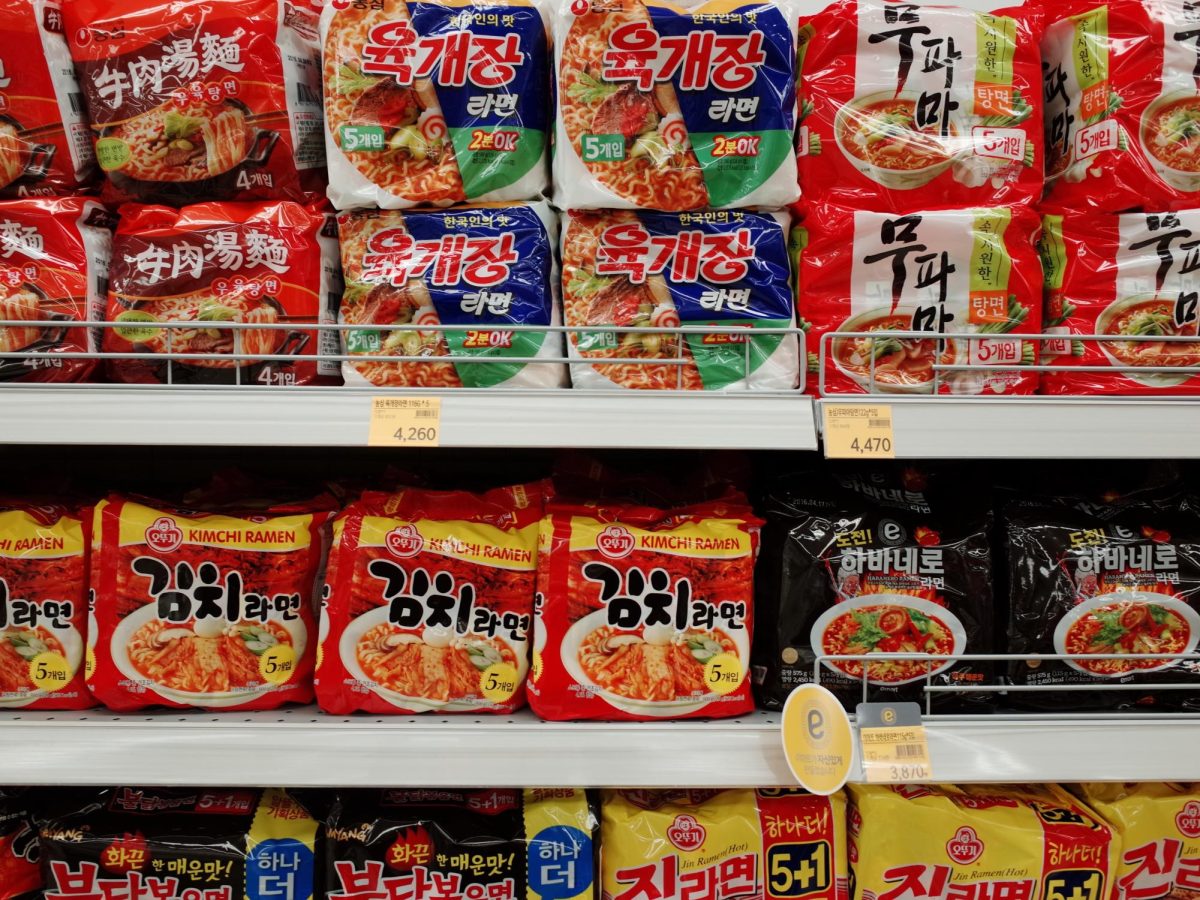







Crying in H-Mart by Michelle Zauner is a memoir that navigates multiple stages of grief. H-Mart, the largest Asian supermarket chain in the United States, is referenced as a pilgrimage site. H-Mart is described as the one of the few places in the country where Zauner’s family could easily acquire delicacies that they had bonded over during their time living in South Korea. “H-Mart is the bridge that guides me away from the memories that haunt me, of chemo head and skeletal bodies and logging milligrams of hydrocodone.” This personal story is about the singer and songwriter for Japanese Breakfast and Little Big League. The narrative is structured around Zauner’s upbringing and then following a difficult grieving process after her mother’s death from cancer. We are given moments and excerpts of her life as she narrates her coming of age, her wins, and her personal faults. The reader is given vivid imagery between Zauner’s life experiences and then her connections to Korean cuisine through memories with her mother.
Her memoir discusses the pains of childhood rejection. She notes the back-and-forth experience of having a mother who expressed love oxymoronically. Her mother’s expressions are twisted between a sense of cruelty yet also with compassion “because that was how my mother loved you, not through white lies and constant verbal affirmation, but in subtle observations of what brought you joy, pocketed away to make you feel comforted and cared for without even realizing it.” After this moment, in the same chapter we see an example of how raw her youth was as she recounts moments within her memory as if they’ve just occurred “When I got hurt, my mom was livid, as if I had maliciously damaged her property. Once, when I was climbing a tree in the front yard, the notch I used to hoist myself up gave out from under my foot. I slid 2 feet, dragging the skin of my bare stomach on the coarse bark as I tried to regain my footing, falling 6 feet onto my ankle… She hovered over my crumpled body, screeching relentlessly as I writhed among the dead leaves. I could have sworn she threw a few kicks in.” Zauner later then describes the extent of her attachment towards her mother progressing through her childhood with the sole intent of pleasing her mother. I noticed thematically that Zauner utilizes food as a grounding technique; she describes preparing kimchi as being one of the few ways of reconnecting with her mother and roots “I started making kimchi once a month, my new therapy. I reserved an older batch for cooking stews, pancakes, fried rice, and newer batches for side dishes. When I had made more than enough to eat, I started pawning it off on friends. My kitchen began to fill up with mason jars, each stuffed full of different types of kimchi in various stages of fermentation.” Zauner, through the stages of grief, taps into her Korean ancestry through cuisine as a means of reaching a sense of familiarity and home. A notable figure in this text is the Korean-American cookbook author and YouTuber, Maangchi. Maangchi is the resource that would truly allow for Zauner to recreate her mother’s recipes as she had only cooked by taste. Zauner utilized these foundational skills gained from watching Maangchi as a means of successfully narrowing down the ways her mother cooked their favorite meals.
This memoir is full of ups and downs. Zauner processes her own moments of growth while also acknowledging the indifferences between herself and her mother. The author describes these moments of growth not only in herself, but also in her mother. Her mother, having grown to accept her cancer diagnosis, begins to lose the criticism that was heavily portrayed in her youth. The changed behavior allowed for the beginnings of closure to occur. I personally enjoyed the ways they both altered their behaviors to make amends in these last moments they would have together. Zauner’s mother historically used to be brutal with criticism was suddenly having a changed demeanor. Their relationship together grew as Zauner described herself as a daughter who was just in desperate need of familial love and to be accepted. These moments of raw connection allowed for the closure and amendments they needed to recover their years of both separation and malice. Zauner still would be left with questions unanswered, relying on the last pieces of family in South Korea as a means of gathering insights into positive experiences that gave to the nature of her mother such as a moment where “Nami explained. When they were kids, she and my mother used to perform at my grandfather’s parties. They would wear their own matching outfits, and since they didn’t have go-go boots, improvised with their rubber rain galoshes.” Zauner expressed being surprised to learn all these other aspects of her mother.
It is with enthusiasm that I suggest that others read this memoir. From a clinical perspective, I could see that this narrative gives a wonderful perspective towards how different life experiences are internalized. This is especially notable in the ways that Zauner gives the reader a seat at the table. Zauner’s writing is also done conversationally, where I felt as if I were sharing the space with her as she recounts her experience. Her writing style is very humanizing as we receive long-winded moments of her life. These moments are expressions of warmth as she longs to bring us (the readers) along for the ride. “The kalguksu, so dense from the rich beef stock and starchy noodles, it was nearly gelatinous. My mother ordering more and more refills of their famously garlic-heavy kimchi. My aunt scolding her for blowing her nose in public. Crispy Korean fried chicken. Conjured bachelor nights with Eunmi, licking oil from our fingers as we chewed on the crispy skin, cleansing our palates with draft beer and white radish cubes as she helped me with my Korean homework.” I genuinely found myself nodding along to moments as if I were conversationally with her in the moment. I found myself giving cues like nodding and leaning into the text as the memoir completely sucked me in. It is without a doubt a wonderful read that is easily accessible through our university library.