















Imagine you’ve just been accepted into one of the most prestigious schools in the entire country: Hope’s Peak Academy, a regal and highly respected high school that scouts its students. Unlike other schools, you can’t just enroll—you have to be chosen. Essentially, students are sought out and specifically targeted, which then can result in the individual accepting or declining the invitation—and, of course, nobody would reject such an opportunity.
Hope’s Peak Academy primarily operates differently than other schools. Students who attend focus solely on a specific area of expertise to study, and interestingly stray away from the regular Common Core curriculum.
“Ultimates,” the name of the students that attend, devote time and study to their talent—the thing they’re best at.
Sixteen students, twenty-five days, and zero escape. Trapped and forced to kill off their classmates one by one to survive, with only one survivor able to claim victory.
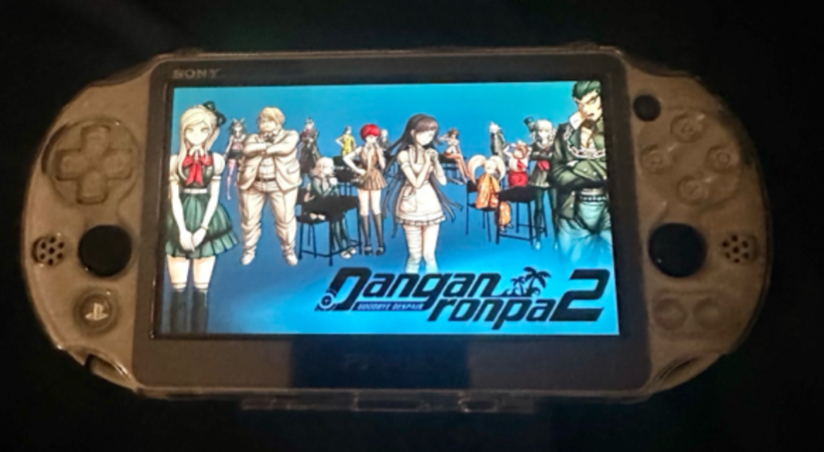
“Danganronpa 2: Goodbye Despair” remains to be one of my favorite video games of all time. In one of my previous articles, I briefly touched on the series as a whole and mentioned this exact title—which is what initially inspired me to continue reviewing the series! I would go in chronological order, but the sequel is cited by many fans, including myself, as being the best entry in the whole series.
The narrative is well crafted, there’s a great cast of characters, and the music is excellent. The sound design never fails to disappoint me. I literally have the entire soundtrack saved in my Spotify just because it’s that good.
The entire game, like its previous entry, is a murder mystery-battle royale, but it differs greatly in terms of its physical setting when compared to the first game. The sequel takes place on a deserted island in the middle of nowhere, which is presented to the students under the guise of “a school field trip.” However, they soon eventually learn that in order to escape off the island, they have to kill another one of their classmates and get away with it. They “graduate,” in a sense.
Hajime Hinata is our protagonist in this entry: a skeptical and pragmatic young man who seemingly suffers from amnesia. He can’t remember his talent and is noted in the game as “The Ultimate ???.” His character arc centers around him overcoming a profound inferiority complex; he envies the other Ultimates for their talents and is faced with confronting the reality of who he truly is.
While this is indeed subjective, Hajime is definitely one of the more interesting protagonists in the series—at least more interesting than the previous one. And now, having been thrust into a killing game, he must fight for his life to survive deadly school life.
Like the previous game, there are a total of six chapters, along with a prologue and epilogue to accompany the narrative. Each one is so interesting and crafted, and some are indeed better than others. Despite this, it features interesting, uniquely crafted murder cases that keep the player engaged and hooked. Every time the story got slow (which was very rare), there was always something that slapped me right upside the head to pull me back in.
The cast also did an amazing job at keeping me engaged and interested; everyone’s so uniquely written and developed (well… some more than others), and their stories are all so engaging. Like its predecessor, the game features “Free Time Events.” You can hang out and spend time with some of the students each chapter, and can even give them gifts to learn more about their character lore—definitely one of the more interesting aspects of the game as a whole.
However, nothing tops the gameplay experience during the Class Trials.
Class Trials are events in the game that occur after a murder takes place. The students are tasked with snuffing out “whodunnit,” the murderer, and must come to a vote when they discover their identity. If guessed correctly, the murderer is brutally executed as punishment for getting caught. But if the other students guess incorrectly, everyone besides the murderer is executed, and they are granted freedom to “graduate” as the winner of the killing game.
One of my favorite chapters in the game is chapter four. For context, in each chapter the students are given a motive for murder. Each one is different and unique, and changes from chapter to chapter. Chapter four is, in my personal opinion, the most unnerving.
The students are locked inside an amusement park funhouse and are presented with motivation for the killing game: either kill another student or face starvation. Unless a killing occurs within the walls of the funhouse, the students inside will inevitably starve to death. It’s a grueling motive for the participants involved, and was even more grueling for me on my first time playing. The entire investigation was so confusing to me, as the culprit used the funhouse’s labyrinthian layout to their advantage for their crime.
The execution the culprit receives is absolutely gut-wrenching—not because of the violence, but rather the heartache. The murderer of this case is known for his talent with handling animals, and carries a quartet of hamsters in his pocket everywhere he goes; it’s a cute little detail the developers included for his character, and he’s easily become a loved character in the fandom.
Before his execution, the culprit protectively puts his beloved horde out of harm’s way and faces his punishment head on, and the hamsters observe as their owner dies in front of their eyes.
Danganronpa 2: Goodbye Despair is beloved by most who play it. It’s easily earned its spot as the best entry in the entire mainline series—at least from my own perspective. While Danganronpa: Trigger Happy Havoc executes its darker tones much more efficiently, the more heightened and colorful tone doesn’t take away from the fact that it’s considered the best one.
However, I will say that I enjoyed the ending of the first game more rather than the sequel; the latter is over the top and is downright unserious—but I still liked it nonetheless! I will also say that I was very surprised with the surviving cast, specifically with who survived and who didn’t—because man, oh man, I didn’t predict correctly at all when I first played!
And honestly, if I had the power to change the outcome of the surviving roster, I would definitely swap some out for others.
In 2025, Danganronpa 2×2 was announced: a remaster of the original Danganronpa 2: Goodbye Despair that features revamped character sprites, background art, and more. Along with the original scenario comes a new story to play through—new murders, new victims, new executions, and a new story.
I swear to God, I have been into this series since I was in middle school; it was the first of my many hyperfixations, the first series I ever truly got super deep into. I cannot explain how excited I am for 2×2 to be released. Apparently, it’s said to be released in November of 2026, and I’m ALREADY growing impatient. I need this game to come out ASAP!
I highly recommend this game to any who are interested in playing. However, if you are planning to do so, you absolutely need to play the first entry, Danganronpa: Trigger Happy Havoc; doing so will result in Goodbye Despair’s story and ending having less narrative impact.
Overall? 11/10!! It’s definitely one of my favorite visual novels in all of existence, and I urge you to play if you are interested!
Danganronpa 2: Goodbye Despair is available on PSP, PSVita, PS4, PS5, Nintendo Switch, Xbox One, Xbox X/S, and iOS & Android. It’s super accessible and seemingly is on nearly every gaming platform.
What are you waiting for? There’s mysteries to be solved. Fight the past to move towards the future in this incredible visual novel.