




Note: Spoilers for the game’s ending
My junior year here at WSU has been all about photography, and I can definitely say I’ve used my digital camera a lot more than ever. My father had gotten me it as a Christmas gift when I was younger; I don’t remember the exact age or Christmas I received it, but it’s easily one of my favorite gifts that I’ve received during the holidays. And due to the privilege of being able to own one, I thankfully didn’t have to loan a school camera (there’s nothing wrong with loaning. I just didn’t want to deal with the stress of accidentally breaking an expensive camera). Because of my courses requiring me to use my digital camera, it inspired me to revisit an old and obscure video game title–a classic PS2 entry that’s incredibly rare to get ahold of physically.
I have this weird thing with video games: I generally fall in love with the sequel. This has proven true with a few franchises, e.g., “Silent Hill 2”, “Resident Evil 2”, “Danganronpa 2”, “Manhunt 2”, “Metroid 2”, “The Last Of Us 2”, “Dark Souls 2” and many more. And it seems that this entry falls into the criteria. However, I will say that Fatal Frame II is the most popular entry in the series out of the five mainline titles that there are. The only other one I’ve played is the first game, but I haven’t finished it because of time, school, and my job—and also the fact that it’s a terrifying game.
And the sequel was all the more terrifying.
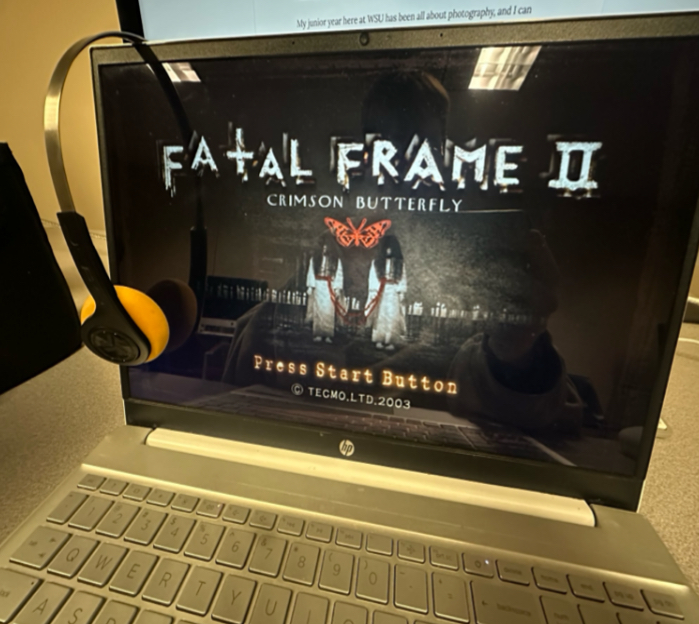
I remember playing the original PS2 version of “Fatal Frame II: Crimson Butterfly” sometime in September of 2025 on my school laptop through emulation. Thankfully enough, my old and reliable (barely hanging on) laptop has carried me through my emulation journey and has allowed me to play titles I didn’t previously have access to. But like the first entry, I never ended up finishing it–mainly due to time constraints. However, with the new release of “Fatal Frame II: Crimson Butterfly Remake,” it’s safe to say that I have reached the story’s conclusion.
Fatal Frame II has an interesting written narrative, despite the fact that I haven’t even finished the entire series. The story is based around Mio and Mayu Amakura, two teenage twin sisters trapped within a haunted settlement cryptically known as the “Lost Village,” or Minakami Village. In childhood, the two girls used to play in the forest near the village. In a flashback it’s shown that while playing one day in the forest, Mayu fell into a ravine while chasing after her sister and permanently damaged her leg. This event caused the two sisters’ relationship to become dysfunctional, and the beginning of the game shows them revisiting the location where it happened. However, through supernatural manipulation, the sisters are lured into Minakami Village, and become trapped within the settlement. Any attempts at leaving the village results in them being transported back inside, as the perimeter is seemingly enchanted.
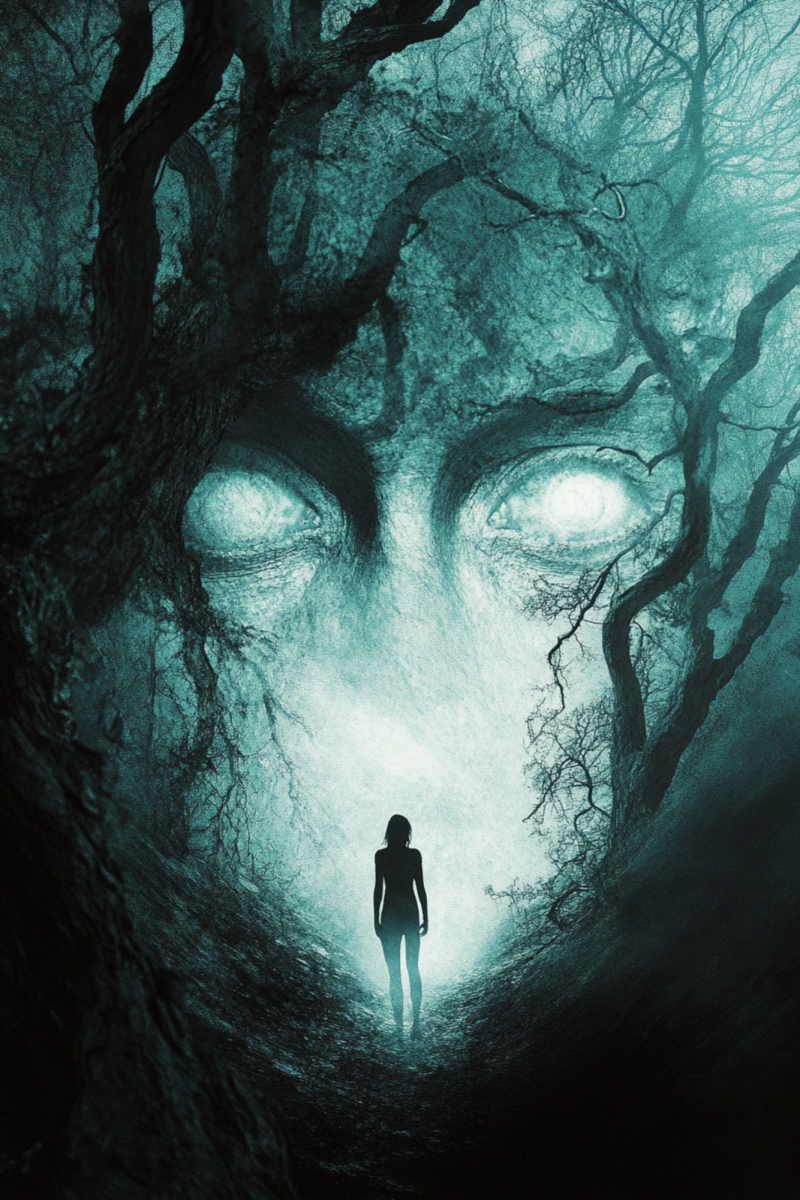
The game’s atmosphere and ambiance are an absolute 10/10 for me. It reminded me of Silent Hill’s in a way; the darkened shadows and gloomy roads really paint an ominous image: something really, really terrible has happened here. The town’s in ruin; homes look as if they’ve been ransacked, wooden panels and walls are broken down, and worst of all…there’s spirits lurking about. In the beginning, you’re essentially defenseless against them, as you don’t have the necessary tools to defend yourself quite yet.
The Camera Obscura is, well, obscure. It’s a camera that’s capable of seeing spirits and paranormal phenomena by looking through the viewfinder and was created by a man named Dr. Kunihiko Asou, who is an unseen character and doesn’t physically appear until later entries in the game–specifically until “Fatal Frame V: Maiden of Black Water.” While exploring one of the village’s structures, Mio and Mayu both stumble upon the device and discover its contents. The two–with Mio taking the initiative to protect her sister–are forced to fight their way out of the house by taking snapshots of hostile roaming spirits. If they get too close to you during gameplay, they’ll attempt to strangle you and you’ll lose a percentage of your health. The same goes for your sister, Mayu, who will also be attacked by the spirits in the midst of a pursuit, and her death will result in a game over. Video game escort missions, like the name suggests, involve the player escorting and protecting a vulnerable NPC from hostile targets. I learned from Resident Evil 4 and Silent Hill 2 that this type of gameplay is definitely a challenging one; the stress of having to babysit does indeed bleed through, but I can confidently say that escort missions are one of my favorite types of gameplay. I remember my first time ever playing this title, specifically during this initial moment when I discovered the camera. I genuinely had to pause the game and set my controller down because I was just that scared!!
The Camera Obscura, along with being a key item to the story’s gameplay and plot, can be upgraded as you progress. After each picture you take of a spirit with the camera, you gain a certain amount of points to level up the camera’s powers and abilities. These points can fluctuate based on the angle at which you take the shots, along with how long you focus the camera lens on the spirits; focusing long enough will make the viewfinder’s grid shift from a tawny yellow to a scorching red hue–which will indicate when you will be able to initiate critical shots. These critical shots, also known as “Fatal Frames,” will reward you with more points and will allow you to upgrade the camera’s capabilities even further. Through the story you’ll also find yourself unlocking new abilities for the camera—such as a tracking mode, a knockback lens, and even one where you’re able to paralyze spirits in their tracks. It’s a straight linear path, with each lens you find becoming increasingly more powerful. The combat and gameplay is definitely one of my more favorite aspects of thisentry. It reminds me of the Nintendo entry Pokémon Snap, a title where you take snapshots of Pokémon in a similar fashion to that of Fatal Frame II. Through all the game’s terror and haunting visuals, I couldn’t help but feel a sense of…deja vu? Like I had played this game before.
For those of you who know me personally, I absolutely love music. Sound design is very important to me when it comes to media. A movie, song, or videogame could have the worst cinematography, worst lyrics, or worst gameplay but have an outstanding soundtrack and I’ll still love it. Sound design is the most important aspect of any medium for me, and this game really outdoes itself. It seriously gave me the chills, the way enemy encounters are filled with the droning of ghostly moans and static–it seriously put me on edge through my entire playthrough.
The game’s story, albeit a rather short one, moved me incredibly when I first finished it. For context, I went in completely blind for the first time playing it. At first, I’ll admit that I had very critical feelings about the conclusion. If you don’t care about spoilers, then by all means continue reading; Mio kills her twin sister in the canonical ending. Yup, you heard that right. The main character ends up killing the closest person she holds dear to her. I will admit that I was absolutely PISSED when I first got this ending. I mean, WHAT???
So you’re telling me that we went on a manhunt-wild goose chase for our twin sister around a haunted village, all for her to DIE?? It felt like the entire journey was in vain. I mean, the entire game is essentially just trying to make your way back to Mio, trying to find a way to escape together, and the canonical ending is the tragic ending? I would be lying if I didn’t say that the ending is incredibly anti-climatic, and I would be lying even more if I said that I didn’t have some harsh feelings regarding it.
Don’t get me wrong. This game is absolutely amazing, and there are a handful of other endings you can receive to remedy this one. But it truly felt like someone just ripped a carpet out from underneath; all of this, ALL of this, it was for nothing. The main goal was to protect our twin sister, find her and escape together, and you fail. What makes this ending even more heartening is Mio’s reaction to what she’s done. For context, shewas possessed by the spirit of a ghost and was essentially forced to strangle her sister. Mio’s sister, Mayu, seemingly transforms into a red-crimson butterfly upon death. She flutters up into the sky as Mio futilely reaches out for her, but it’s no use; she’s gone. Mio is then allowed to leave the village upon her sister’s demise.
Why would the developers do this, you may think? Tragic endings are nothing new; they’ve been around for centuries, written in playwrights and novels. The game truly made me believe that the two would escape together! But mind you, there are a handful of other endings, though they aren’t canonical. So why would the writers choose such a tragic route for an ending?
Well, the story was never truly just about them.
For context, Minakami village follows an interesting ideology and philosophy. It has this thing called “The Abyss,” a sacred pit where The Crimson Sacrifice takes place. The Abyss, for lack of a better description, is a gateway to hell. It’s hungry, and to satisfy its hunger it needs a human sacrifice every so often—or else it will open pandemonium in the village; it’s like a starving deity that threatens to destroy the village unless satiated. And The Abyss is a picky eater.
It demands specifically a twin sibling for the sacrifice; the village has an ongoing tradition where two twins are sacrificed every so often to The Abyss to appease its will, specifically with the older sibling killing the younger one. And before Mio and Mayu, there was Yae and Sae.
Some time before, before we even arrived in Minakami village, Yae and Sae both lived within the settlement together and were a planned sacrifice for The Abyss. However, what everyone didn’t know was that both twins planned an escape; not wanting to die, they escape into the night to avoid the ritual and attempt to outrun a mob of villagers. However, Sae doesn’t want to run. Deep down she wants to be sacrificed so that she can be together forever—even in death, as she is severely emotionally attached to Yae. And while making their escape into the forest, thinking her sister would stop, Sae purposefully falls into a ravineand severely hurts herself. But Yae, filled with desperation, is so focused on escape that she doesn’t even realize she gets separated from her sister and continues to run. And eventually she escapes, never to be heard from again. In a way, Yae haunts the narrative. Despite this, her story does continue and she’s mentioned in later installments, more specifically in Fatal Frame III: The Tormented.
Upon discovering Sae, the villagers panic. They needed a sacrifice, and they needed one now. And so they panic. They sacrifice Sae by hanging her in an effort to somehow appease The Abyss, but the ritual goes haywire and The Abyss essentially rejects the sacrifice. What would transpire next is known as “The Repentance,” an event that caused the inhabitants of Minakami village to perish.
While the story of Fatal Frame II centers around sisters Mio and Mayu, it tells a parallel story to another set of characters that mirrors their own. It was really interesting catching that on my first play through. The game is a tale of familial trauma, as our two sets of twin siblings both share an unhealthy dynamic; with one twin being toxically dependent on the other. Fatal Frame II, albeit a tragic ending, shows the audience how a single action can change the course of one’s life, another’s life. A butterfly effect, if you will.
If I were to seriously rate this game, I’d give it a 8/10. A bit of a lower score for me, mainly just because of the ending. I really enjoyed the gameplay and atmosphere, and the sound design was excellent. If you’re interested in playing Fatal Frame II, I suggest just playing the remake. The remake has everything the original has–including new cutscenes, new content, new endings, etc. Personally I was hoping for more with the canonical ending, but beggars can’t be choosers, right? If you’re looking for a game that will make you cry, piss, and shit yourself, hey, look no further.
This was an experience I had a blast with, despite the ending being a bit less than expected. If you have an opportunity to, I highly recommend purchasing the remake. It’s on the cheaper side, only fifty dollars (which is actually super cheap for games nowadays…sadly…) and I finished it in about roughly fifteen hours.
So what are you waiting for? The Lost Village awaits you.