















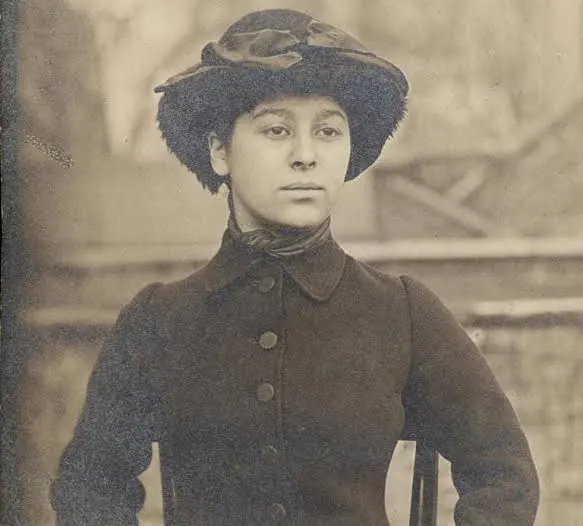
“There are other things which make happiness besides pleasant things happening to one… Our own self-respect, and the integrity of the people we care for.” – Amy Levy, The Romance of a Shop
Amy Levy is a Victorian poet who died in 1889 at the age of 27 during the peak of her career, resulting in her work falling into obscurity. She was certainly praised for her work; it’s said that Oscar Wilde defended Levy, calling her “A girl of genius” when she was being criticized for controversy. Having the ability to sit and analyze her work piques my interest as she writes with such sapphic-energy that also completely embodies a sense of despair. This is especially noticeable throughout her final collection of poetry A London Plane-Tree and Other Verse, a collection published just months before her death by suicide. It is there we see Levy falling into obscurity for essentially a full century as she was rediscovered in the late 1980s – early 1990s. Levy is still regarded as an underappreciated artist, and thus I take this time to shine a spotlight.
“A Wall Flower” is a poem pulled from her section “Odds and Ends.” In this piece she is describing a scene of feeling misery for witnessing a romantic interest dancing amongst a group of men. “I lounge in the doorway and languish in vain / while Tom, Dick and Harry are dancing with Jane.” This is the first stanza, which gives a profound beginning image of being completely depleted by witnessing this display of affection. She follows it up with describing her feet to being a “leaden fiend.” Levy describes that there is something unconscious within her that’s preventing her from engaging in Jane. This heavily resonates with the idea of internalized homophobia as she is describing something internally. This poem shows us the comparison of her feet being ridden with this fiend that is preventing her from even attempting to engage with her. Her third stanza solidifies her daydreaming of having the ability to dance with Jane.
“Borderland” is featured in the same collection and under the section “Love, Dreams, & Death.” This poem is concretely about being between two different spaces as she describes uncertainty to being awake or sleeping. In a very queer perspective, this poem is about intimacy. It is the desire for a joyful night to last forever, never wanting a moment to come to an end. My direct comparison of this is that a “downy bird” (a real breed of bird) is used to represent a woman that Levy is sharing a night with. The pet-name “Bird” is a term of endearment derived from British slang as a means of an affectionate pet-name. “A downy bird, with an odorous wing. / That fans my forehead, and sheds perfume, / as sweet as love, as soft as death.” This adds context that this “bird” lingers of perfume whose touch is so sweet and compares death to a sense of softness. My conclusions of this lover’s embrace are solidified by “My heart in some dream-rapture saith, / It is she. Half in a swoon, / I spread my arms in slow delight— / O prolong, prolong the night, / For the nights are short in June!” this gives the idea that it’s more of an encounter for a same-sex union instead of the idea that Levy is simply being visited by a bird. The italicization of “it is she” truly gives the idea of waiting—anticipating this moment.
“To Vernon Lee,” which is written underneath the section “Moods and Thoughts,” is a piece that spotlights both Levy’s desire for same-sex intimacy and her intense feelings of loneliness. Her approach to this poem embodies the sapphic energy of being held in embrace; she is looking entirely for someone to recognize her. It’s reminiscent of good times— where the expressions of being together are shared through descriptors of the environment. “When the year was young / We wandered, seeking for the daffodil / And dark anemone, whose purples fill / the peasant’s plot, between the corn-shoots / sprung.” The concepts of love and death are woven and expressed through the symbol of flowers. I interpret the idea of daffodils being reminiscent of new beginnings and optimism while the dark anemones being recognized for their symbolism towards a forsaken love—being lost and anticipating more. It is additionally important to note that Vernon Lee is a pseudonym for Violet Paget, a gender-nonconforming writer that Levy had an unrequited love for. It is where an interlocutor, Carolyn Lake, reminds readers that Levy had numerous letters and correspondences with Vernon Lee. This poem is one of the many that express an intense desire for romantic connections. The common theme is that there was never reciprocation of love towards her.
Levy wrote a handful of novels such as Reuben Sachs, The Romance of a Shop, and Miss Meredith. Reuben Sachs faced controversial backlash as it was believed to be antisemitic for being stereotypic. The Romance of a Shop novel consists of 19th century women who are encountering the challenges that are apparent when pursuing the independent life. Oscar Wilde describes her work as being full of “sincerity, directness, and melancholy,” notably recognizing Reuben Sachs as “a classic.”
Carolyn Lake approaches Amy Levy from multiple perspectives including her being queer, taking the time to acknowledge the sapphic writings that come from a plethora of Levy’s poetic works. She noticeably does a queer reading and interpretation (as Levy had expressed romantic desires for women through multiple poems and letters.) It is still important to note that Levy would actively reject being labelled as a queer poet, much like she would reject being classified as a Jewish poet. Levy had come from an Anglo-Jewish family, and within her letters it is apparent that she drifts into atheism and ditching the idea of adhering to labels.
Amy Levy is relevant to our present-day lives as she navigates her longitudinal decline in mental health. The reader can imagine her deterioration through her recognized-self stories. I find her life story to be deeply important to showing readers the vast ways someone may express their difficult emotions. It displays the idea that as social creatures we need community. The inability for Levy to access mental health care and personal companionships through her queer identity expose the intricacies that resulted in her tragic death. This is why I found her work to be relevant to our diligent desire to de-stigmatize mental health, recognize the early signs of crisis, and to give resources to individuals in need. The purpose of giving light to her poetry also is that it aligns with individuals who are struggling with their sense of identity. Her poetry allows others to empathize and see that they’re not alone.