















When I was in middle school, specifically in seventh grade, I discovered visual novels. A visual novel (or VA for short) is a form of media where the individual taking in the story is also interacting with it too. Most visual novels are labeled as video games, however, not all fall into this category and are flexible with labels. While VA’s are prominent everywhere in the world, they originate from Japan. And overall? Visual novels are definitely my favorite type of video game. I mean, a video game that also has the elements of a novel? Two of my favorite things combined into one??
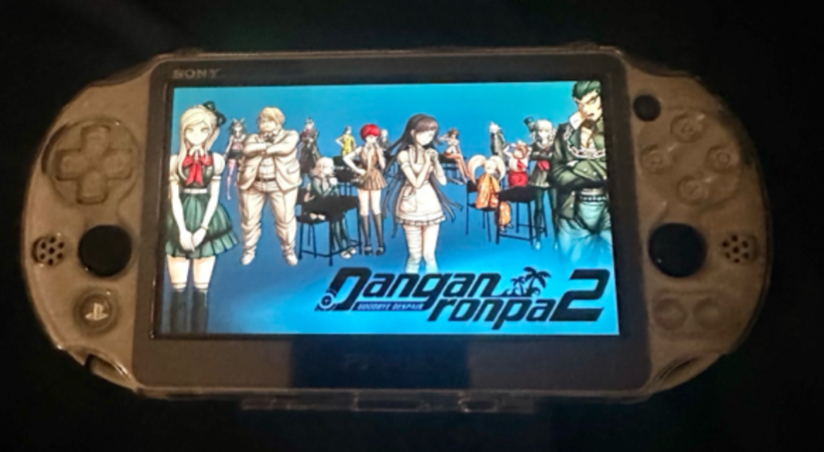
The first ever visual novel that I discovered was “Danganronpa: Trigger Happy Havoc,” a title that was released in 2010 originally for the Playstation Portable (PSP). At the time, I didn’t own the hardware to run the game–which meant that I had to resort to watching Youtube gameplay videos. It would only be years later when I would actually play the video games myself, as the entire series was eventually released on the Playstation 4 (PS4). And coincidentally, I recently purchased my own Playstation Vita (PSV) and had the entire series downloaded on its contents.
There are three central entries within the series, and it has a handful of spinoffs to accompany it as well. After “Danganronpa: Trigger Happy Havoc” comes “Danganronpa 2: Goodbye Despair,” the direct sequel to the first game. And finally afterwards, “Danganronpa V3: Killing Harmony,” the threequal. Each game has a wide cast of characters, plot twists, and more. I played the games in chronological order–and I cannot stress this enough–play them in the right order if you intend to get into the series! There are plot points and twists that are meant to be revealed in a specific order, and playing them in the right order will ensure that the twists are properly executed. And while Danganronpa features multiple titles, I will be focusing on the first entry–for the sake of chronology.
In a world where talent is seemingly everything, there’s Hopes Peak Academy: a prestigious high school where individuals with profound talent are scouted by the institute. These individuals are known as “ultimates.” Ultimates are, well, ultimates. There’s an ultimate swimmer, ultimate writer, ultimate baseball player, and more. Essentially, ultimates are the best at what they do. However, the school isn’t exclusive and allows those who share the same talent to attend at the same time (e.g: multiple “ultimate detectives” can exist.)
For those who are “talentless” that wish to be accepted into the school anyways, Hopes Peak does an annual name drawing to give “talentless” students a chance to attend. The individual who is chosen is dubbed “The Ultimate Lucky Student,” as they’re “lucky” to be the one to be pulled. Makoto Naegi is our Ultimate Lucky Student, specifically the Ultimate Lucky Student of the seventy-eighth class at Hopes Peak Academy.
The introduction of the game also, of course, introduces our protagonist: a seemingly normal guy who seems extremely eager to start his new life at the school. But before he can step inside, his world–literally–darkens, and he falls unconscious before he makes his way inside.
Upon awakening from his slumber, Makoto finds himself seated in a standard school desk inside a classroom. But upon further inspection…it’s no ordinary classroom. Iron slabs are drilled and secured over the windows–essentially blocking off a view of the outside. After further collecting himself, Makoto ventures deeper into the school. Upon further exploration, he finds his other classmates: fourteen other students–the ultimates.
After the introductions between all the students have concluded, they are instructed by a mysterious voice over the intercom to make their way towards the school’s gymnasium. When they arrive, they are greeted by Hopes Peak Academy’s very own principal, Monokuma; a black and white bear that then informs the students that they are now trapped within the school’s walls (as seen by the iron plates over the doors and windows) and will spend “the rest of their natural lives” within.
The machine-like bear doesn’t beat around the bush here, and informs the students that the only way to escape their confinement is to kill another student and get away with it. If another student is to kill another and their body is found by the others, the students are then tasked with investigating the crime scene. Afterwards, “Class Trials” are held, where Makoto and the rest of the students must find out who committed the ultimate crime, and are tasked with voting for who they believe is the killer.
If the students guess correctly, the killer is punished–more specifically executed–for their crime. But if guessed incorrectly, everyone besides the killer is executed, and the killer will be able to “graduate” (escape) the school.
The stakes are high–which is what initially drew me into the series. And while I was mostly driven in by the plot and the initial concept as a whole, I never expected myself to like the characters so much! I will also say that out of all the mainline entries into the series, “Danganronpa: Trigger Happy Havoc” portrays the best tone. While the other entries are great, the first game really hammers in darker visual tones, ones that completely outmatch the others.
If you’re new to the series as a whole, I am seventy-five percent sure that your favorite character will indeed die. It’s inescapable. Having favorite characters in a series such as Danganronpa is a losing game. I won’t say who, but I was absolutely destroyed when one of my favorites was killed off!
For context, while the game is a visual novel, it includes these sections dubbed “Free Time Events.” Free Time Events (or simple FTEs) are sections of the game that include the player spending time with the other students. You can get to know their character lore and personality as a whole.
During Free Time Events, you can also present gifts to the individual you choose to spend time with. Each one corresponds to each student, and the gift received can entice different reactions based on if they like or not–and they even have the potential to flat out be disappointed with what you give them.
For a game such as Danganropa, these Free Time Events give the player a sense of “normalcy.” But all it takes is the discovery of a corpse to shatter one’s daily life.
Danganronpa is certainly one of my favorite titles. Along with the gameplay and core story is a sense of nostalgia for me. It’s been years since my initial first discovery of the series, and it’s one that I will never, ever forget.
Battle royales and death games have always been some of my favorite narrative tropes in the media, as the stakes are so insanely high. It’s a battle of life and death, hope vs. despair, and Danganronpa is a series that really turns everything you know about the death game genre upside down.
There are similar games, sure: Both “999: Nine Hours, Nine Persons, Nine Doors” and “Ace Attorney” come to mind. But Danganronpa has such a unique approach, such a way of executing (pun not intended) plots and character arcs. It’s nothing like I’ve ever seen before, and I haven’t seen anything like it–at least not currently.
Is this a game that I would recommend? Wholeheartedly! The characters are all quirky and interesting, and if you’re really into investigation and murder mystery, Danganronpa is right up your alley. How would I rate it on a scale of 1-10? 11, most definitely.
If you have the chance, you should definitely give this game a chance. As of 2026, all the Danganronpa games are on most modern consoles; Nintendo Switch, Xbox, Playstation, PC–even ios/android! It is super accessible.
So, what will it be? Hope? Or Despair? You decide.